I spent much of my childhood in Houston, Texas, where hurricanes are just part of what we had to deal with. If you’ve seen a meteorologist and a chart as they’re talking about a hurricane, you’ve probably seen a cone of uncertainty: a representation of what we think we know about the hurricane’s path, typically starting narrow with what’s happening right now and then expanding as we move into the future. Essentially, it illustrates that we have some idea of where the hurricane is headed, but the farther out we’re talking, the less certain we are.
In a vendor selection effort, we take the cone of uncertainty in reverse: we start with a wide-open view of what we’re looking for, and then we narrow in through analysis and due diligence to identify the option that seems to meet our needs most effectively.
We typically start with several dozen solutions that might work based on our experience and expertise. As we get clearer on what we need and what solutions have to offer, the list of options shrinks to more like 10, then 5, then 3, and then 1.
Why Create Vendor Selection Field Notes?
From both a personal and professional perspective, it feels like we’re selecting technology vendors all the time right now. Whether it’s experimenting with new AI-centric tools, replacing our core technology solution, or simply finding a new scheduling app, we’re navigating lots of analysis, tradeoffs, and decisions.
The process of selecting a new technology and/or implementation vendor can be nerve-wracking: what if we miss a major red flag? what if a key use case isn’t addressed well? what if we spend all this time and effort, and the tool never actually gets adopted?
With over a decade of experience in leading vendor selection efforts, I’ve developed some strong preferences and thoughts on how to navigate the twists and turns of analysis, consideration, and decisioning to get the results we’re seeking.
My aim with these field notes is to equip you to navigate a vendor selection effort with confidence, whether or not the FlexPoint team is involved.
For FlexPoint clients embarking on a vendor selection effort, I hope this gives you a good sense for how the coming weeks will look and feel. For those tackling the entire process in-house, I truly hope that you feel equipped to navigate the ebbs and flows of this adventure well.
Who Are These Field Notes For?
I’m sharing the activities that the facilitator and selection team should expect to work through, coaching on what to watch out for along the way, and tools and artifacts to create for the best results. These notes will be most relevant to the facilitator of a vendor selection effort – I get really in the weeds on what to do and how, to give you enough information to do this yourself.
For the sponsors of a vendor selection effort, I strongly recommend that you read this introduction to understand the broad strokes of what your team will be working through, plus two specific sections that will be helpful in your role:
In Align on Our Top Pick, review the Lead vendor negotiations activity to determine the best person for this role and to see specific recommendations
In Land the Plane Well, review the Lead vendor contracting activity to understand several contracting watch-outs from the FlexPoint team’s experience
Desired Outcomes of a Good Vendor Selection Effort
Increasingly, business leaders may be wondering: why should I even bother with a big vendor selection process like this? Why should I invest resources in a project – internally or with a consulting partner – when ChatGPT can just recommend the tool we need?
I’ve found that a well-designed and well-executed vendor selection effort yields several outcomes, going beyond identifying which tool to use going forward.
Of course, we’re aiming to decide which vendor(s) to select. This typically means we have a solution that meets business and technology needs, with an implementation team teed up with requirements, approach, and high-level timeline.
But what we’re ultimately after is confidence: we want decision-makers to feel confident that they have done enough analysis, consideration, and due diligence to make the best decision they can.
(We always encounter surprises in vendor selection efforts and subsequent implementations, but we’re aiming to surface as many surprises as we can, as early as we can, to set the selection and implementation up for success.)
Part of this confidence coming from finding a partner, not just a vendor. We want to build a lasting partnership with a technology vendor based on proven fit – not only vendors’ requirements fit but also their compatibility around culture and ways of working, since there’s plenty of work that follows the selection effort.
An added bonus for the vendor selection team is that they’ve practiced doing hard things together. This will pay dividends during implementation, as they will need to analyze more information, make more decisions, and take action together.
Top Ten Vendor Selection Lessons
Before we jump into the details on how to lead a vendor selection effort, let’s start big picture. Here are my top ten recommendations for a vendor selection effort:
Focus on finding a partner, not just another vendor. Determine the best option according to the combination of requirements fit, approach, and culture. Consider the vast set of data points gathered through this approach – formal RFI responses, small talk in demos, reference checks, and more – as a wealth of information, and make the best choice based on what you’ve learned. In negotiations and contracting, remember that we’re aiming to build a long-term partnership, not just score short-term wins.
Lead with curiosity. Begin each phase curious about what you and the rest of the selection team will learn and decide together. Be open-minded in how you’ll solve business needs going forward – you may find that a product you’ve never heard of is the best fit. You may even approach the solution in a totally different way than you’re currently thinking. Aim to balance risk aversion with the opportunity to find a partner that can truly enable business challenges going forward.
Make sure you actually need a vendor selection. If you already have a strong front-runner, take a step back and get some perspective. Is it a better use of everyone’s time, effort, and resources to conduct a proof of concept with the top one or two options? Alternately, perhaps you’re laser-focused on the specific technology product, rather than thinking through vetting partners. Focus on answering the right set of questions.
Engage with difficult conversations in real time. A vendor selection effort is like a freight train: it’s difficult to stop or turn around. That means we all need to speak up when we have thoughts (particularly thinking that’s counter to the prevailing direction), so we can plot the best possible course together. Approach disagreements like a detective: seek to understand why someone else has a different perspective or conclusion than you do, rather than being quick to defend your position.
Communicate with vendors like your attorney is listening. Approach every phone call, email, and meeting with a vendor as if it will be read out in a courtroom or presented on a billboard. (Be particularly careful to choose your words when declining vendors. Be respectful and firm, without oversharing.)
Watch the fine print. Ultimately, this evaluation process ends in a set of binding agreements. Take your magnifying glass and critical eye into negotiations and contract review, making sure to specify all product components you want to use and watching out for renewal terms that leave you open to risk.
Protect the selection team from vendor pressure. The facilitator should be the single point of contact with vendors throughout this effort. If vendors try to use back channels or contact selection team members directly, they must redirect all contact to the facilitator to ensure fairness and to prevent unintentional over-sharing.
Reference checks are incredibly important – make the most of them. Even hand-picked vendor references reveal information that’s helpful in evaluating the option and in preparing to adopt a new solution, whether with this product or another. (If we can secure informal references through our own network, this unfiltered view will likely be even more valuable!) In due diligence, we’re aiming to look around the corner and anticipate as many potential challenges and risks as we can – then make a good plan to address them.
If progress stalls, look for the reason behind the reason. Particularly as we get closer to a final selection, indecision may be driven by a general fear of messing up, rather than a specific objection. In that case, bring the group back to the rigor of our analysis and due diligence to restore confidence in moving forward.
Enthusiastically support the final decision, even if it wasn’t your top pick. This is a group effort to uncover the option that will best serve the organization in the long run. Keep any disagreements within the selection team and be aligned in your recommendation.
A Preview of What’s to Come
In the following blog posts, we’ll walk through the basics of the FlexPoint Consulting approach to vendor selections in enough detail that you can lead a selection effort well. We’ll share key activities to complete, analysis to conduct, and artifacts to create.
We’ll also dig into what success looks and feels like, with some watchouts and tips based on over a decade of experience in the trenches. (These range from “how to make an inevitably uncomfortable conversation less so” to “how to prevent threats of legal action from vendors you don’t select,” all from very real experience.)
A vendor selection effort goes quickly, and each phase build to the next. I recommend considering all of the activities pictured on the next page before beginning, getting clear on the participants and resources (like: “who will conduct legal review?” and “do we have a standard mutual non-disclosure agreement to use?”), then really digging into each phase’s activities as you go through the process.
FlexPoint Vendor Selection Approach at a Glance
How do we achieve our desired outcomes? The FlexPoint team has a standard vendor selection approach that we start with and customize to each project.
For the purposes of these field notes, I’ll use the example of selecting a software solution and a partner to help us implement it. A vendor selection can focus on just an implementer, or a set of related tools, but we’ll keep things straightforward in these notes for illustrative purposes.
At a high level, we take a selection team through a requirements prioritization process, determine suitable vendors to receive a Request for Information, work with vendors to understand how their solutions can fulfill prioritized requirements, narrow down to a handful of vendors for demos, facilitate due diligence, and ultimately get the selection team a procurement-ready contract and implementation plan.
We also help the selection team identify the best implementation partner who has proven experience and knowledge with the software solution who can help guide initial and long-term usage. With the selection team, we complete thorough due diligence so they can be assured that the selected partner has good references and that they have an airtight agreement that protects their interests in the long run.
I hope that narrative gave you a flavor of what we tackle in a vendor selection. The graphic on the next page includes each phase (listed chronologically, from left to right), with what we’re seeking to accomplish, and key activities to be completed by the facilitator and by the selection team.
Sometimes the selection team has specific procurement rules they need to follow, or they want to take this opportunity to create ideal customer journeys, or they’ve already started drafting requirements and we just need to review and prioritize them.
In all of these instances, we take our standard vendor selection approach as the starting point and tailor it to achieve the desired outcomes as effectively as we can.
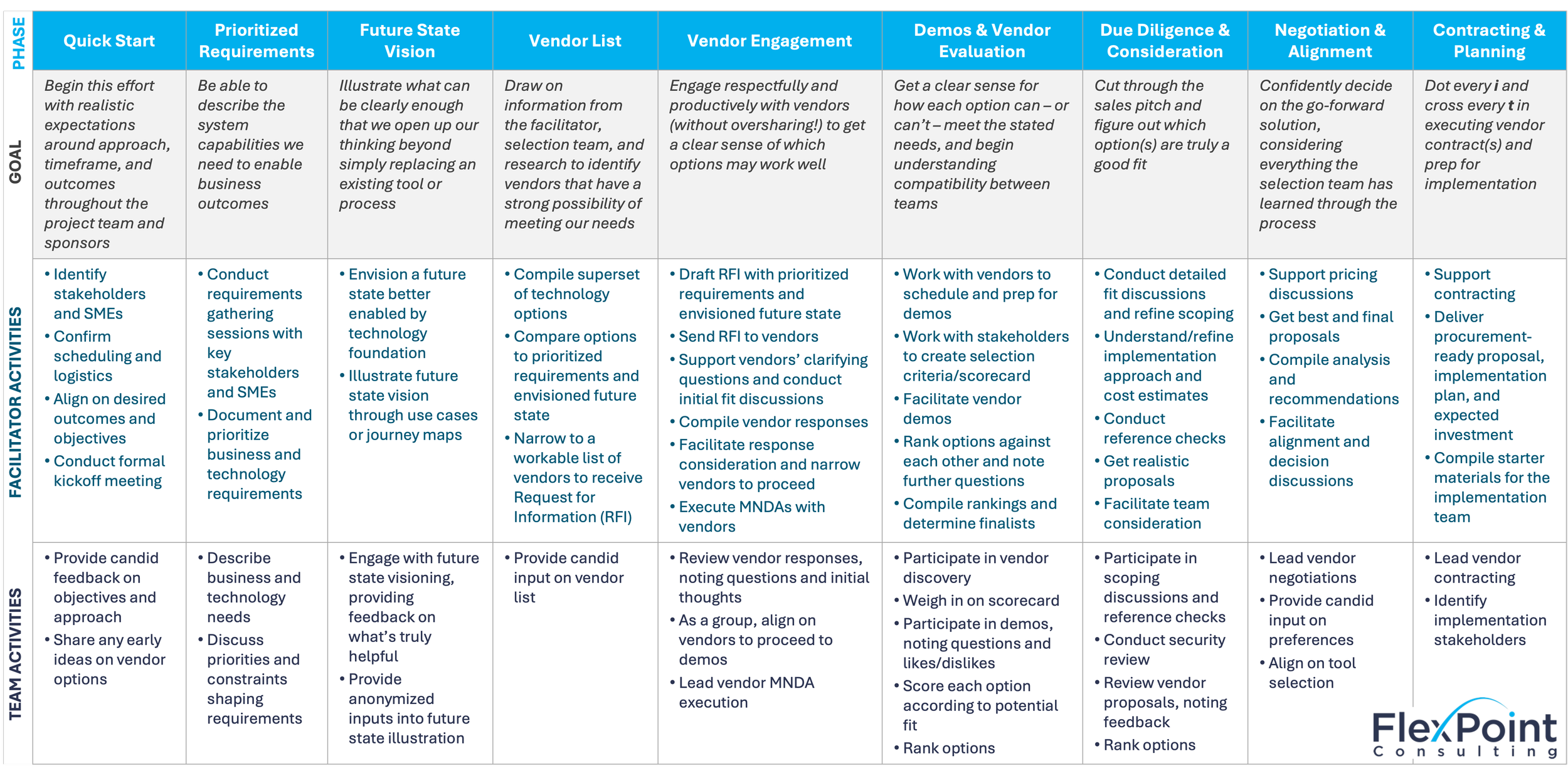
FlexPoint Vendor Selection Approach
Connect with the FlexPoint Team
I truly want these field notes to equip you to run a vendor selection effectively and confidently.
If, instead, they’re prompting more questions than answers, please set up time with me using this scheduling link. I’m happy to talk through questions, pushback, you name it.
If you find yourself saying, “who even has time for this; don’t you know we have day jobs?” we can help. The FlexPoint team has facilitated many platform selections, and we offer our clients:
Expertise without an agenda: we don’t have a vested interest in which solution they choose, we just want to help them find the option that best supports their ongoing success.
Experience managing vendors: we’ve been through the sales pitches, juggled vendors’ insistent phone calls, and gotten to the heart of whether solutions truly offer the benefits clients seek. We act as an advocate and a shield for clients through the process.
Anonymity through the initial stage: we withhold the client’s name during the initial consideration stages, until we’re ready to sign mutual non-disclosure agreements in advance of demonstrations and more detailed fit discussions.
No matter your path forward, we’re rooting for you to find technologies and partners that truly meet your needs, now and in the years to come.