The start of a vendor selection effort is a mix of excitement and trepidation. Memories of tools that didn’t live up to the hype and implementations that went sideways can be close at hand. And yet, we’re seeking a new solution for a reason, so dreams of manual processes being automated and buggy reports being replaced are also on our minds.
As facilitator of this effort, our goal is to harness the excitement and learn from the challenges… and start to build momentum quickly.
I find this is best accomplished with curiosity about the outcome and confidence in the process. What will we find? I don’t know! But I am confident that we have a path that will get us to a good answer to that question.
This Phase at a Glance
In the Quick Start phase, our goal is to begin this effort with realistic expectations around approach, timeframe, and outcomes throughout the project team and sponsors.
In the spirit of surfacing surprises as quickly as we can, Quick Start is when we want to understand any disconnects we have between facilitator and selection team, or within the selection team itself. These can be anything from tools or vendors that are on someone’s do-not-use list to different understandings of the scope to be addressed.
Here are facilitator activities at a glance:
Identify stakeholders and subject matter experts
Confirm scheduling and logistics
Align on desired outcomes and objectives
Conduct formal kickoff meeting
Here are selection team activities at a glance:
Provide candid feedback on objectives and approach
Share any early ideas on vendor options
At this point in the project, our vendor count is unknown. As facilitator, we should do some research beforehand to understand the lay of the land, but we’re far from having firm thoughts on the superset of options. And selection team members likely have some vendors in mind from previous experience or their own research.
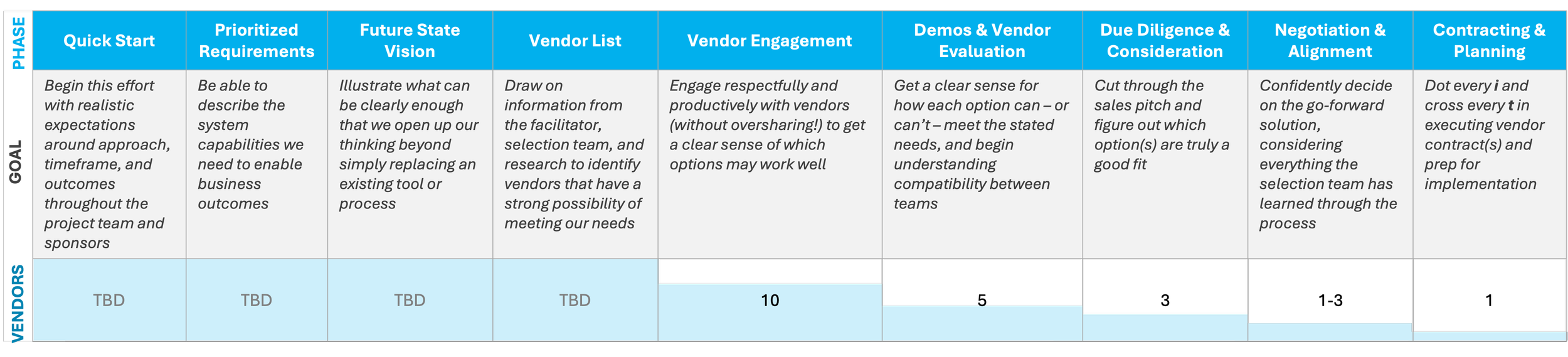
This graphic illustrates the estimated vendor count by phase
Key Activities
Let’s walk through each of the activities in this phase, with what success looks like and considerations to work through.
Identify stakeholders and SMEs
Typically, there are a few people acting as the driving force for a vendor selection effort. If we’re talking about an ERP for a financial services firm, perhaps it’s the Controller and a senior analyst who gets asked to run a bunch of reports every month because the current solution isn’t super intuitive. To stick with the ERP example but shift over to an energy company, it may be operational leadership saying, “we want to know about issues before our customers report them to us.” (In that case, the selection effort was multi-faceted, including an ERP, field service management, telemetry, and more.)
The job for the facilitator is to engage with those driving early progress and together build out a selection team with the expertise to speak to what is needed and the authority to make decisions on the topic at hand (or a direct line to that authority).
The group should be small enough that everyone’s voice can easily be heard in brainstorming and deliberative conversations… and big enough that we’re not asking people outside of the group for input each week.
This can be a difficult balance, particularly in organizations where everyone is accustomed to being included in everything. In that case, I recommend having a working group of hands-on experts that presents recommendations to the larger group. The working group will do most of the analysis in the vendor selection, and the larger group will be consulted on decisions. Just be careful to identify true decision-makers ahead of time, so we’re not paralyzed by the need for consensus in such a large group.
Among stakeholders, I recommend identifying project sponsors, preferably including a leader of each major functional or technical area to be impacted by the selected solution. Sponsors act as visible leaders of the selection effort:
Sponsors make sure to clear roadblocks for the selection team’s productive involvement.
When competing or unclear priorities arise during the vendor selection effort, sponsors create clarity and allow the group to move forward.
If the group gets stuck in analysis or decisioning, sponsors provide leadership on decision criteria or act as a tiebreaker.
It’s often the case that the selection team recommends a vendor to the final decision-maker. Sponsors take the group’s recommendation and reasoning to the final decision-maker and work with the final decision-maker to select the best solution for the entire organization.
Identifying stakeholders and subject matter experts can take several weeks, since it likely includes getting buy-in from leaders whose team members will invest real time into this project. Aim to have a solid list of participants by kickoff, with the option to refine together.
Confirm scheduling and logistics
Vendor selection efforts move quickly, with considerable time and expertise demands of the selection team. So, it’s smart to have a well-defined project timeline and to have selection team members reserve time in their schedules to focus on the effort, potentially even off-loading some responsibilities if possible.
The duration of each phase depends on the type of solution you’re seeking, how complex your requirements are, how many people are on the selection team, how many vendors you decide to engage… you get the idea. So: I tend to start with an estimate of one to two weeks for each of the first four phases, and then more like three or four weeks for each of the remaining phases, when we’re dependent on back-and-forth’s with vendors and references.
We can predict fairly well when big blocks of time will be needed for specific roles: see the graphic below.
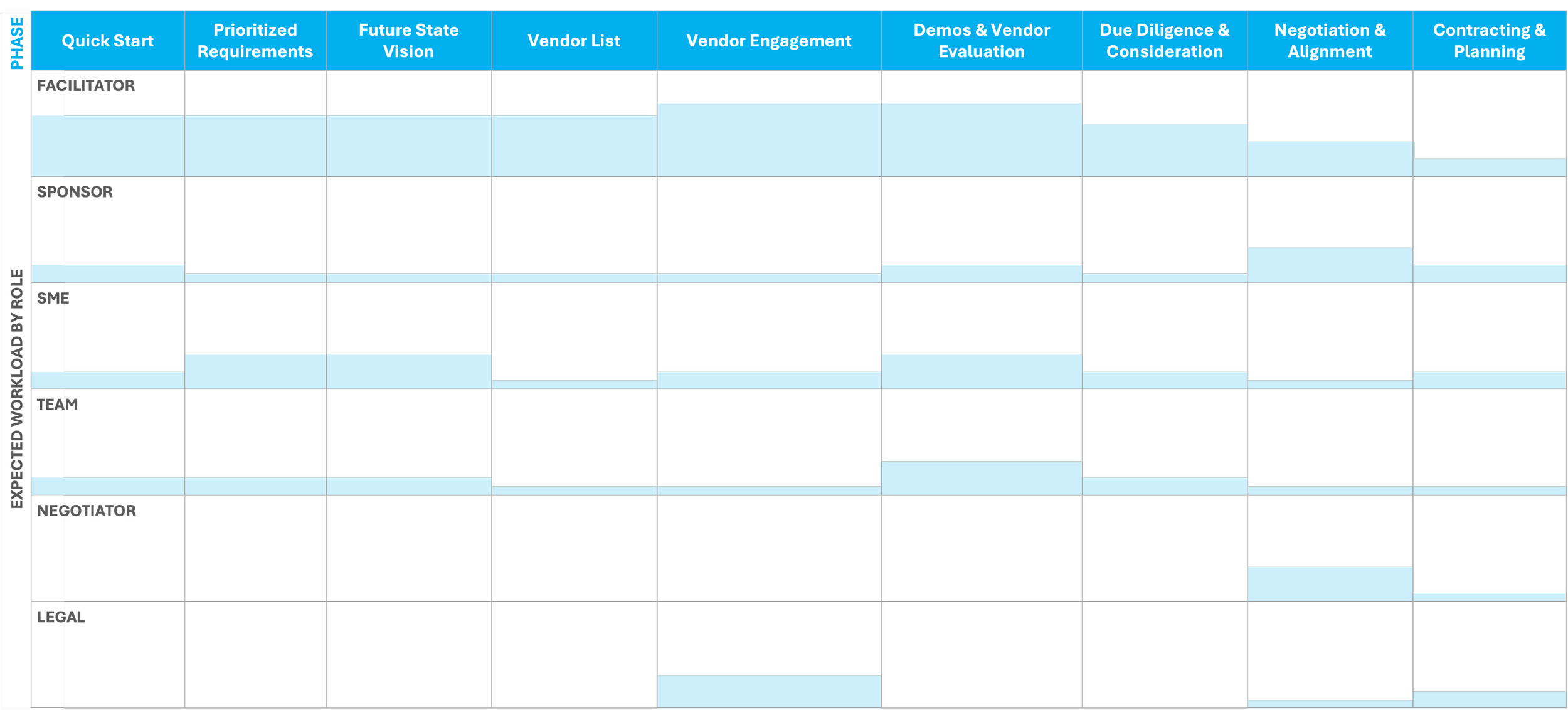
This graphic illustrates the relative workload across the facilitator, sponsor, selection team, and more
As the facilitator, make sure to build known commitments into the project timeline. This might include conferences, holidays, significant weekly/monthly/quarterly commitments, and more. (Also include some buffer in your published timeline to accommodate a few delays.)
The challenge comes in when we introduce vendor teams, who have their own commitments and constraints. I typically communicate the entire selection project timeframe to vendors from the get-go, telling them when I expect to schedule demos, reference checks, negotiations, etc. so they can be as prepared as possible. (This doesn’t prevent the dreaded, “our solution architect has a two-week vacation during your demo slot,” but at least it pulls the conversation forward and gives the option to adapt resourcing or timelines early.)
Expect to talk about scheduling and logistics with sponsors ahead of the kickoff meeting, and then to make some updates with input from that and subsequent discussions.
Align on desired outcomes and objectives
Now we’re getting to the fun stuff! Work with project sponsors to draft goals, scope, and timeline as you understand them.
At this stage in the effort, we’re not aiming to be perfectly correct. Rather, we’re aiming to present information clearly enough that the sponsors and selection team can formulate specific questions and provide productive redirects. A simple (not easy, mind you) diagram of which functional and technical areas seem in bounds for this effort goes a long way. Similarly, a process list that highlights the areas that we expect the new solution to enable can shine a spotlight on what matters for us now.
You’ll use this information in two ways – in an introductory message to project participants and in the kickoff presentation – so keep it simple and lightweight. Expect feedback and refinements, both from the intro message and from the kickoff meeting, so be prepared to iterate through versions.
Slowing down to write up goals, what is (and isn’t) in scope, and the expected timeline may not feel value-add in the moment, but this provides a strong foundation for the effort, particularly if the team gets shaky on priorities and constraints midway through. In some cases, we may not resolve every open question, but at least we’ve posed them and know we need to work through them.
Have a project sponsor send an introductory message to project participants with the draft outcomes and objectives and ask participants to contact the sponsor directly with any questions or concerns.
Make it clear to the selection team that you want candid feedback on objectives and approach before and during the kickoff meeting. It’s far better to work through areas of misalignment or misunderstanding early in the vendor selection effort than to let them simmer for weeks and blow up later.
Then schedule the kickoff meeting, referring to the intro message so people can easily connect the dots. I typically schedule a 45-minute kickoff, to provide enough time for discussion but not to get into the weeds on any particular topic.
It can be tempting to wait until what feels like the perfect moment to kick the project off. Resist this urge. Find the best option within two weeks of deciding to move forward with this effort and keep progress going.
Conduct formal kickoff meeting
In the kickoff meeting, walk through the driving force behind this effort, desired outcomes and objectives, roles and responsibilities, and timeline with the cross-functional team to be involved in this effort. The kickoff may include a larger audience than just the working team; in this case, make it very clear who is doing what and how/when the working team will bring back updates and questions to the larger group.
I like to say that I’d rather have a spicy kickoff than a silent one.
We’re not looking for quick head nods and getting out of the kickoff meeting. Ideally, we have a substantive conversation about what is driving this effort – and we incorporate additional perspective based on the kickoff participants. And, if discussing expectations brings up disagreement or surprises, it is much better to work through those as the project begins than weeks into it.
I’ve been in plenty of kickoffs where I show the scope diagram or list and several people chime in with questions like, “what about…?” That’s great! People care about getting this right. While it provides some friction in the moment, this is far more effective than getting farther down the path and needing to revisit thoughts and decisions.
Use part of the kickoff meeting to talk scheduling and logistics at a high level, but don’t get too stuck on this topic. It can be helpful to have selection team members share their out of office time with the facilitator after the kickoff meeting, to plan important milestones around.
I often like to talk vendor options in the kickoff, since I’ve been surprised with “wait, what about this option?” more weeks into a vendor selection effort than I’d prefer. If people have specific solutions or implementation partners that would be excited to work with based on previous experience, are intrigued by, or are unwilling to consider selecting, this is great information to have.
This is also a solution scope check: if team members are naming lots of options that aren’t on the facilitator’s radar, maybe we have more work to do to get on the same page on what problems we’re aiming to solve with this solution. We’re not committing to a shortlist (or even a longlist) at this point; we’re simply getting everyone’s prior assumptions and initial thinking out in the open.
Advanced Class
If the selection team and/or sponsors are new to working closely together, you may benefit from taking a bit of time to build rapport within the selection team. This will allow your project-focused time to be used more effectively, as participants spend less time trying to parse through new teammates’ ways of working and can focus on the job at hand.
At the end of the vendor selection effort, we’ll likely have multiple negotiations to conduct: up to three solution vendors, and potentially separate implementation partners. Work with sponsors to identify who will lead negotiations. If they aren’t a sponsor of the effort, make a point to share the project timeline and a bit of context with them. Also, make sure you know what’s helpful to hand off to them in support of negotiations, so you can build this through the effort.
Finally, it can be incredibly helpful to do some informal reference checks on solutions or partners we’re considering. So, file away relevant information as people mention vendors during kickoff: knowing that Tina knows someone who uses a tool x allows us to take action on that information later.
Tools & Artifacts
Quick Start relies more on discussions than artifacts, but we’ll do well to get a few key items going:
Create a stakeholder list, with each of the participants involved in the project, with their specific role for the project and contact info
Draft an introductory email to be sent by a project sponsor, which describes the project at a high level and explains why the people receiving the email are involved
Create a kickoff meeting presentation, with as clear a description of what we’re doing in this project and why as we can get (as mentioned above, we’re aiming to align on expectations, which means we want to elicit any surprises or disagreements now, rather than later)