

Copilot Catalyst Field Notes
Practical thoughts on what actually worked to successfully roll out Microsoft 365 Copilot
We had just finished mapping out the perfect Microsoft 365 Copilot rollout. Every failure point anticipated. Every detail meticulously thought out. The program design was bulletproof.
Then our CEO said, “This is great. Now can we do it in half the time and at a quarter of the cost? We’re meeting with the executive sponsor this week to discuss kickoff...” What followed was fast and intense. That conversation forced us to figure out what actually mattered versus what just looked good in a deck.
Copilot Catalyst launched as our structured approach to company-wide AI adoption. We’ve now seen how it plays out across departments, functions, and different organizational personalities. Some things we designed worked exactly as planned. Others didn’t land the first time and required quick adjustment.
To share what we’ve learned so far, AI adoption expert Steven McPhee compiled eight lessons that repeated across every pilot. They’re the things he’d tell someone starting their own Copilot rollout tomorrow to think about. Not theory. Not best practices. Just what actually worked.
The FlexPoint Consulting team works hard to help clients envision, plan, and deliver business transformation.
FlexPoint Field Notes provide a practical, candid, and — we hope — immediately actionable frame on a current business transformation topic. They go beyond a “behind-the-scenes” look: they include how our thinking has evolved as we’ve learned over time.
Think of Copilot Catalyst Field Notes as a field manual for enterprise AI adoption.
It includes our best thinking on how to navigate challenges well, and we hope it will spark creative thinking, questions, and things you’d like to experiment with going forward.
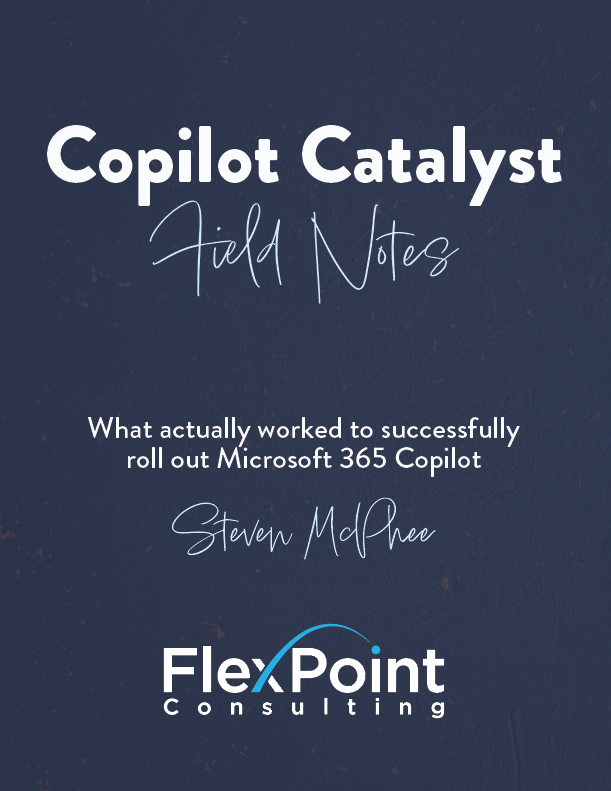
Click on the image to open the file (no email required — it’s yours to enjoy!)
Want a printed copy with room to jot down your own field notes?
Fill out this form and we’ll send you a copy, no charge.
Here are the list eight lessons detailed in the field notes linked above, if you want a sneak peek before digging in!
What moved the AI adoption needle? It was executives who can tell their own Copilot story. Leaders who engage first remove fear and model curiosity. Enthusiasm cascades down. When a VP can say “here’s how I used it yesterday” instead of “how is the pilot going?” direct reports feel the freedom to experiment. Instead of a handful of high performers lobbying for a broader rollout, executives are leading the charge and telling the story that keeps the investments flowing.
Lesson 1: Leaders Go First, or Nothing Goes Anywhere
Long pilots feel safer, but an extended pilot season can drift and lose urgency. The sprint phase drives immediate engagement, accountability, and visible results. Intensity creates urgency while slow and steady always leaves time to get to it tomorrow. We learned to start with a short, high-energy sprint, then pivot to measured reinforcement.
Lesson 2: Sprint Beats Marathon
AI moves too fast for feature-based training to stay relevant but fluency compounds forever. Self-sufficiency beats tips and tricks. We stopped teaching “click here, prompt this” and started teaching exploration, error recovery, and peer learning. The result: within three weeks, over 85% of pilot users know how and when to use Copilot and can either self-solve or peer-solve issues when they arise.
Lesson 3: Teach People to Fish; Don’t Give Them Cool Tips
Three good experiences create an advocate. Three bad experiences will create a vocal skeptic who stalls momentum across entire departments. People approach AI with strong pre-existing opinions, and early frustration hardens those opinions fast. First impressions can’t be left to chance. They need to be designed. We learned to curate first tasks, structure exploration, and engineer deliberate quick wins. Then step back and let people explore on their own terms.
Lesson 4: You Get Three Chances to Make a First Impression
Adoption doesn’t spread through training decks. It spreads through conversations. One enthusiastic manager outperforms ten great workshops. One skeptical VP can freeze an entire division. Direct reports model what leaders model. This is social and behavioral, not technical. We learned to cross-pollinate teams, share real stories, and work across departments.
Lesson 5: Culture Is Contagious; So Is Resistance
Copilot is the very first step, not the finish line. If set up correctly, it is the entry point to a broader AI conversation. When users with limited LLM experience start using it, they begin to see AI as a collaborator, not just a tool. That shift opens up strategic thinking and leaders start asking bigger questions about AI-enabled workflows, not just personal productivity through Copilot.
Lesson 6: Copilot Is the First Step, Not the Destination
Saved time and efficiency gains are like fertilizer: they help everything grow stronger but are hard to measure on a balance sheet. To sustain investment, you need crops: tangible outcomes such as revenue growth, cost avoidance, and reduced downtime. Balance exploration with accountability, or budgets evaporate over time.
Lesson 7: Fertilizer Helps Growth; Crops Justify Funding
Most companies ask, “Where can we use AI?” We have learned that could be the wrong question to ask at the start for an established enterprise. “AI-first” can work for startups strategically making bets on AI’s promise. But for companies with thousands of employees and billions in revenue, adoption has to solve real business problems. The right approach: business-first AI strategy, not AI-first business strategy. Put on your AI blindfold. Look at your processes and pain points. Identify what needs improvement. Then match tools to problems. Sometimes AI is the best solution, sometimes it’s not.
Lesson 8: Business-First AI Strategy, Not AI-First Business Strategy
Thoughts? Questions? Other perspectives based on your experience? We’d love to discuss.
Set up time with our team using this scheduling tool.