You may be saying to yourself at this point, “isn’t this about vendor selections? where are the vendors?” They’re here! In this phase, we narrow down to a workable number of vendors to receive a Request for Information.
To do so, we take everything we’ve learned about what we do today and what we’re seeking going forward, then compare that to vendor offerings in the market.
In these field notes, we’re using the example of seeking a software solution and implementation partner for simplicity. But, as we’ve compiled requirements and future state vision, we may have shifted our thinking on what kind of solution works best for us. This decision path can be simplified as “build, buy, or bot.” Let’s walk through each of them.
When we say build, we intend to create something custom for ourselves. In that case, we probably still need some tools (like a platform, application building toolkit, or infrastructure) to pull together several components in our custom build.
When we say buy, we mean that we’re seeking a full solution that has the features and functionality to meet our needs within a marketed product. (It’s common wisdom that, when we buy a product, we want to customize it as little as possible, to minimize maintenance headaches going forward. So, we’re aiming to understand how native and configurable capabilities can meet our needs.)
The term bot is already getting dated. Let’s extend that to purchasing or creating a chatbot, or even purchasing or creating one or more agents, to accomplish what we’re after. This still includes a vendor component for the vast majority of us, since we’ll want to use prebuilt tools to accelerate our efforts on the standard parts of the project, focusing on building/tailoring efforts on the parts of the project that are most valuable or unique to us.
This Phase at a Glance
In the Vendor List phase, our goal is to draw on information from the facilitator, selection team, and research to identify vendors that have a strong possibility of meeting our needs.
Here are facilitator activities at a glance:
Compile superset of technology options
Compare options to prioritized requirements and envisioned future state
Narrow to a workable list of vendors to receive Request for Information
Here are selection team activities at a glance:
Provide candid input on vendor list
At this point in the project, our vendor count is moving from a fuzzy bunch to more like 10 specific options that we think may be able to work for us. This is still a hypothesis – subsequent steps are all about testing and refining our thinking on vendor fit – but our cone of uncertainty is starting to narrow.
Key Activities
Let’s walk through each of the activities in this phase, with what success looks like and considerations to work through.
Compile superset of technology options
Start off by generating a long list of options that have a chance of meeting our needs going forward. Don’t do deep research on each tool just yet; if it has a chance of being a good fit, put it on your list. I like to use several different research methods at this point and mark down where I found an option, so I can retrace my steps if needed.
I also like to take note of seeing an option via multiple methods, so make space for that in your analysis notes. I typically have a simple list in a spreadsheet, with columns for each of the research methods I’m using to jot notes and links. That way, I can see that Option A showed up via five methods (with notes on each) and Option B in two of them.
Here’s the start of a research method list for you to build on, with pros and cons of each. I recommend embracing the iterative nature of this process. Aim for a long list that you can refine in the next step. Once you aren’t learning much anymore as you take another pass through analyzing options (i.e., you hit diminishing marginal returns), you’ve done enough research.
Familiar Options
Start by including vendors that the facilitator and/or selection team have had experience with that might work here. You have direct (or nearly direct) knowledge about these options, so you’re not relying on strangers’ thinking, which is helpful.
But… our understanding might be incomplete (the previous scenario might not overlap completely with this one) or stale (features and pricing change meaningfully over time). Particularly if our experience with a tool was more than five years ago, previous weaknesses may have been addressed or comparative strengths eroded by competitors’ efforts.
General Search
It’s no-brainer to do a wide-open search on the capabilities you’re seeking and common solution names or acronyms that seem to fit the requirements. You can benefit from outside perspectives and information that otherwise wouldn’t have crossed your radar.
Your search is confined by the terms you use, and some solutions have very specific ways of defining themselves, so expect to do several rounds of searching with different terms.
And watch out for advertisements: seeing which options pay for sponsored listings (on their own or competitors’ search terms) can be illuminating, but it’s obviously with a specific point of view.
Generative AI Research
AI-based research options are growing and becoming both more powerful and helpful. Definitely take advantage of these resources but be careful about information latency (some models have a cut-off date for information they’ve considered) and the reliance on consensus information (particularly if you’re seeking more of a niche product).
I recommend using sources and reasoning to get fuller context for the information being served up. And, of course, pressure test all the information you find (like you’re doing for all of these sources).
Expert Reports
Technology advisory firms (like Gartner or Forrester) spend considerable time and effort compiling lists of the top solutions in a variety of categories, and this information is a high-quality addition to your analysis.
Make sure to read the full report, not just the executive summary or the key graphic. The commentary and caveats matter in your specific analysis, not just the advisory firm’s conclusions. A challenge is that the full reports often aren’t widely available, as they are sold as a valuable resource. (If your organization has a subscription, awesome.) Some vendors provide a portion of the report from their websites, which is helpful, but you can be certain it says nice things about them if they’re sharing it.
Pay careful attention to the solution category in the report. “Product-centric ERP” options won’t be at all relevant to a professional services firm seeking an ERP focused on financial management and banking.
Finally, new entrants or very niche options aren’t well represented in these reports, as the research firms typically have a minimum tenure or customer base for products they analyze. If you’re seeking tried and true options, that won’t be much of a problem, but if you’re aiming for the cutting edge, you may be interested in options that didn’t make the report.
Competitor Comparison
It’s a common tactic for software providers to have “compare us to…” landing pages on their website, showing options they consider to be their competitors (and how they’re better than them, at least in narrowly defined scenarios). This is interesting information and can help you build your web of options, with the appropriate cautions.
Of course, the information you’re getting about competitors is filtered through a perspective that benefits the vendor presenting the information. So, use a particularly critical lens on information gathered through this method.
Specific Ads
I often add options to my long list of vendors by seeing who paid for ads on general solution terms or on a different vendor’s search. These tend to be newer market entrants who are trying to get established but haven’t made it onto the other lists yet.
I don’t have to warn you again that information vendors are paying for you to see is biased at best. Use your judgment and test all assertions made.
I got such a kick out of one competitor-focused ad that I took a screenshot of it:
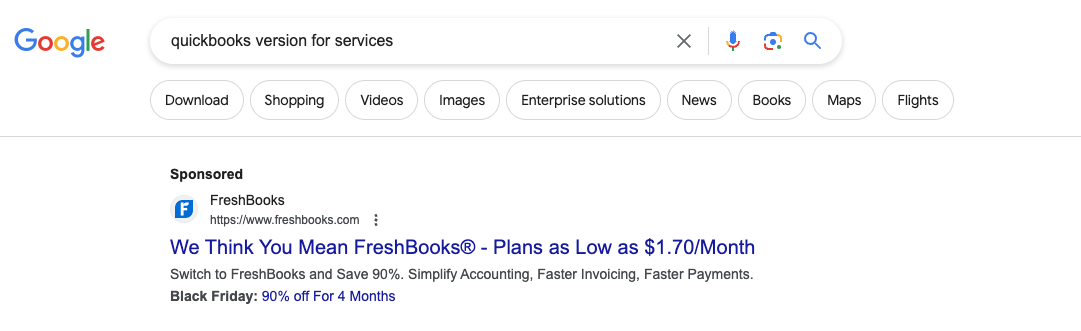
QuickBooks is a long-standing accounting solution for small businesses, and competitors have positioned themselves to address specific features – like improved invoicing for professional services businesses.
When I searched for “QuickBooks version for services,” the first sponsored result was “We Think You Mean Freshbooks” and a specific landing page backing up that claim. Brilliant.
Curated Lists
There are a shocking number of lists of vendor options online. Some are credibly curated… and others are simply generated by the vendors paying for exposure. Even worse, some are just AI slop, sigh.
Throw heaps of salt at compiled lists and rankings and reviews, particularly when they’re in the far corners of the internet. And be prepared to get MANY more ads and cold reach-outs if you spend any time on these list sites.
Consider Adjacent Categories or Approaches
As you’re wrapping up your initial consideration of technology options, think through the possibility of solving the challenge at hand with a different product category or a combination of tools.
I think an example will best describe this. We worked with a client to select an enterprise content management solution. The most straightforward approach was to select a product that specifically aimed to address enterprise content. Our vendor list mostly included these options.
We also explored the possibility of a headless content management platform, that is, an ECM back-end solution that didn’t have a front-end user interface, since a lot of the front-end interactions would be initiated in other tools. (In the end, the client opted for an ECM product, with tailored workflows to integrate it with their existing tools seamlessly.)
Consider including options from an adjacent category or accomplished through alternate approaches in your vendor list. It’s a good idea to start thinking about agentic AI workflows at this point, but don’t stop there.
This can be a great addition to your analysis, but touch base with SMEs or project sponsors to test your thinking before chasing down a lot of details. Exploring different ways of solving business challenges can round out your analysis and build even more confidence among the selection team that they’ve thoroughly analyzed the available options.
Compare options to prioritized requirements and envisioned future state
I like to break this part of the option analysis up into multiple sittings. Once you’ve compiled your long list of potential vendors, set it aside and take a nice long walk. If practical, wait to come back to this part of the analysis the next day, or at least a few hours later.
Now, take a closer look at the options you’ve compiled. Get the lay of the land, noting which options show up through multiple research methods (prioritizing the more credible methods).
Before you dig in to researching each option, I recommend including space to jot notes on potential fit for your requirements and ideal future state. This could look like a set of columns representing your major categories of requirements, or just start with one place to note potential fit and build your framework as you go.
Plus, make space to jot down product positioning notes that will help vet options. This might be industry focus (some vendors are quite specific about who their solution serves), primary geography (for both regulatory compliance and customer service considerations), and target customer size (some vendors are very clear that they’re for small and medium-sized business, as opposed to large enterprises).
With your option analysis framework good enough to capture meaningful insights, go through each option and note potential fit, positioning, and anything you want to be able to refer to later (including links, most likely).
Don’t be afraid to add options to the list while you’re doing this deeper look. Product names can change over time (particularly as products get acquired by other firms), so you may uncover a few seemingly new options that you later realize you already have represented. All good!
Remember, you’re aiming to turn over enough stones now to feel confident in your superset of options.
Narrow to a workable list of vendors to receive Request for Information
Again, I recommend that you take a nice break before this round of analysis. Getting a bit of distance from your earlier thinking allows you to question assumptions and poke holes in initial hypotheses.
With each option understood to some extent, categorize your list on how you recommend proceeding with each solution. This will likely include some strong no’s based on a mismatch of approach, geography, industry, features, etc. (Be kind to your future self and include why you said they were a no.) You’ll likely have lots of maybe’s and a few strong yes’s remaining, which is great.
I often bucket the maybe’s into meaningful categories that help connect the dots between similar options and highlight substantial differences. (Expect to run back through several options as you categorize them, to vet or refine your thinking.)
Sometimes, I realize I have an assumption guiding my thinking. When that’s the case, I like to spell out the assumption, to mention in the upcoming sync with the selection team. (“I think x is disqualifying options based on these reasons. Is that a sound conclusion? What might I be missing?” is the general flow of this thread.)
Create a summary of your findings to walk through with the selection team. For me, this often looks like a few slides synthesizing findings, with the ability to refer to the option analysis spreadsheet to see more details.
I tend to begin with the no’s and work my way through maybe’s to yes’s. It can seem like over-sharing to present the entire initial list to the selection team (and I wouldn’t spend a lot of time going through the no’s), but I like to share the full set of defensible possible options with the selection team. This helps to prevent the “what about that option?” questions later, as we agree on the superset of options considered.
Of course, remove any red herrings from your search, but in general, I like to be transparent with the flow of vendor list refinements, starting from the initial long list.
Consider meeting with the project sponsors before the group session, to get a pulse check and take in early feedback. Then walk through your summarized option analysis with the selection team, incorporate their refinements, and land on a list that’s comfortable for everyone.
Make it clear to the selection team that you need their candid input on the vendor list and try to build in a few days of buffer before sending the Request for Information, to allow for percolation and late-breaking thoughts. Different perspectives on guiding assumptions and how options fulfill them are welcome at this point, but make it clear that we want to align on the list of vendors to proceed (with a clear deadline).
If the selection team really likes to dig into details, I prefer to present the summarized analysis, share the full option analysis for review, allow several days for them to consider, and then have a sync to align on the list. (Alternately, share the option analysis ahead of time with clear guidance on how to understand it, and aim to get to the RFI list in one discussion.)
I typically aim for about ten vendors to receive the RFI, to cast a wide net while keeping logistics workable. For some solution types, ten will be way too many (like if we have very specific compliance needs), but I find that it’s a good target in general.
Advanced Class
If there’s any way to do informal reference checks (like if we know someone who’s currently using a solution on our list), now is the time to do them! This can be a 30-minute call, or a few quick questions by email about their experience with the tool. We often learn a lot in reference checks, even if it’s just what to ask vendors about more specifically.
For instance, I learned that a friend of a friend used a solution that was a strong yes in a vendor selection, so we arranged a 30-minute call to discuss. Learning that they’d had to rely on the vendor team to do more customizations than expected allowed me to ask more detailed questions about this aspect of the vendor’s proposal and demonstrations, and we gained a better understanding of how they could be a fit than we would have otherwise.
Tools & Artifacts
This phase ends with an option analysis list that includes all vendors in consideration and a determination of which will proceed to Request for Information.
For me, this is typically a wide spreadsheet that’s easy to filter, including:
Vendor and solution names, potentially with the source(s) you used to understand each option
Rationale for inclusion in the longlist, with notes on potential requirements fit or product positioning
Determination, likely enriched with a category representing why you and the team decided on the option